




KEYTAKEAWAYS

- KEY TAKEAWAYS
- WHAT HAPPENED: X FORMALLY REJECTS THE INFOFI INCENTIVE MODEL
- WHAT WAS REJECTED IS NOT CONTENT, BUT INFOFI’S INCENTIVE PATH
- FROM “SHUTDOWN” TO “RECONSTRUCTION”: INFOFI PROJECTS COLLECTIVELY SHIFT DIRECTION
- CONCLUSION: THE TALKING-TO-EARN ERA IS OVER, BUT INFOFI’S QUESTIONS REMAIN
- DISCLAIMER
- WRITER’S INTRO
CONTENT
X’s decision to revoke API access for InfoFi applications marks a decisive rejection of posting-based incentive models, triggering market fallout and signaling a broader reassertion of platform control over content production.
On January 15 at 22:39, X announced the revocation of API access for InfoFi applications. Multiple apps that relied on “posting-based incentives” were immediately affected. As APIs were cut off, some projects announced the suspension of related features or adjustments to their business direction. Tokens associated with InfoFi saw sharp declines, with several InfoFi-related tokens (KAITO, COOKIE) recording double-digit drops within a short period. Community members offered a blunt summary: “the talking-to-earn era is over.”
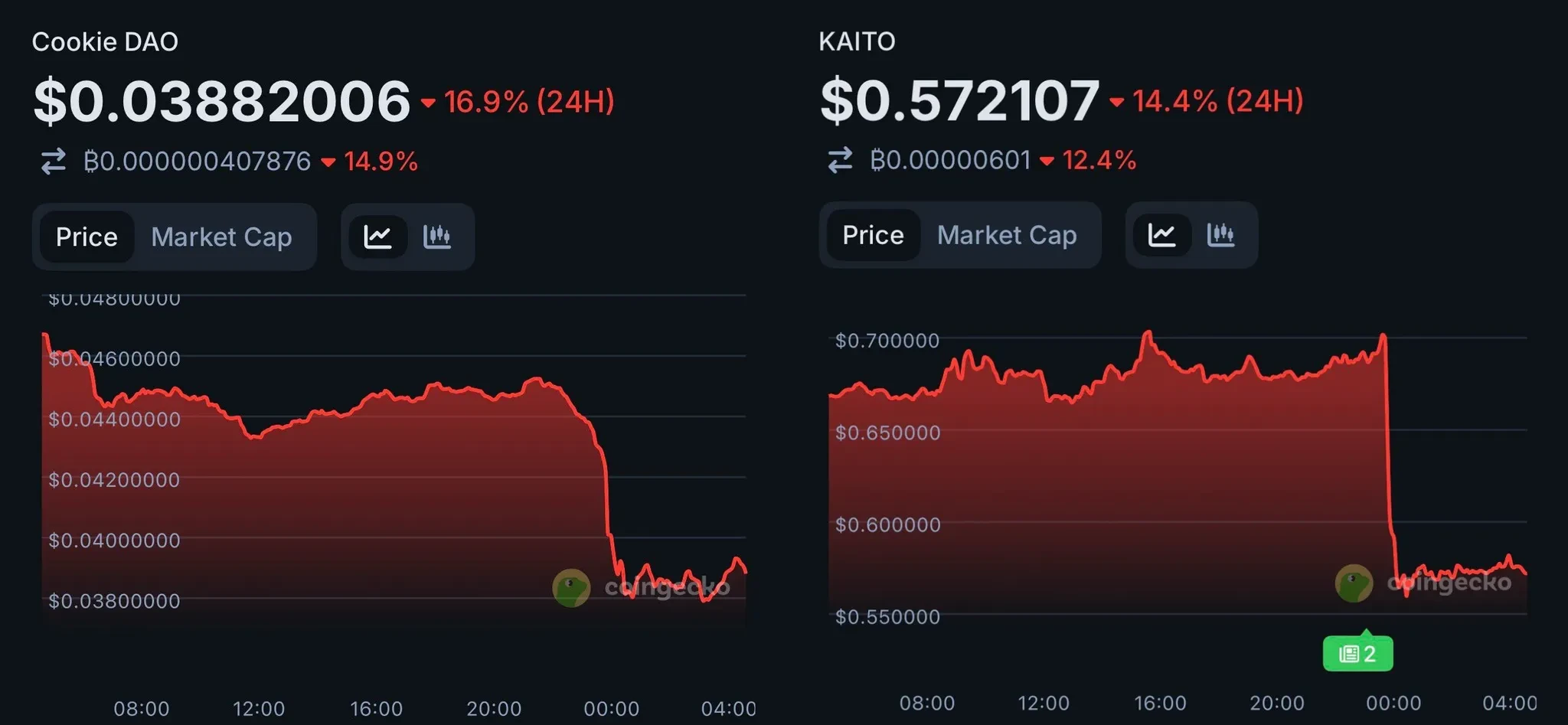
The violent reactions across InfoFi applications and tokens indicate that this change went far beyond a routine rules update. It altered the operational foundations of related apps and triggered cascading market effects. This was not a minor tweak, but a clear statement by X against a specific application model.
WHAT HAPPENED: X FORMALLY REJECTS THE INFOFI INCENTIVE MODEL
This time, X left little room for interpretation.
X’s product lead Nikita Bier stated in a post that X is revising its developer API policies and will no longer allow any applications that “reward users for posting on X” to continue accessing the API. In his description, such apps were explicitly labeled as “infofi” and identified as one of the primary sources of recent AI spam and reply pollution on the platform.
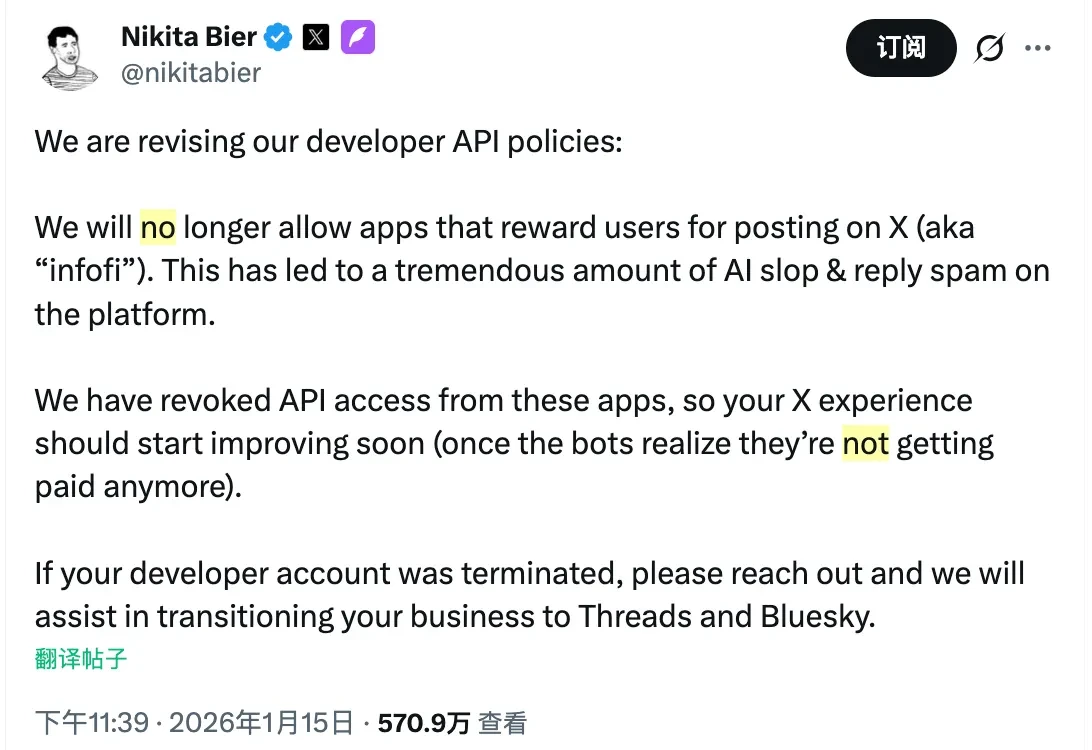
Unlike past platform governance approaches that emphasized advance notice and observation, X acted decisively this time: API access for relevant InfoFi apps had already been revoked. The official rationale was straightforward—external incentive mechanisms were driving a flood of task-based, templated content into the feed, severely degrading the user experience. Once bots realized that “posting no longer pays,” X believes the content environment would quickly self-correct.
Notably, Nikita Bier added a pointed remark: InfoFi applications had previously paid millions of dollars in API access fees, but X does not need that revenue.
That single sentence effectively delivered a verdict on the InfoFi business model. Judging from the execution and official wording, this adjustment was not aimed at isolated cases of API abuse, but represented X’s unequivocal rejection of InfoFi’s core model—external incentives directly intervening in platform content production.
For teams whose developer accounts were terminated as a result, X’s proposed “transition plan” was equally telling: the platform would assist them in migrating their businesses to Threads and Bluesky. In other words, X chose not to reform or absorb this incentive mechanism, but to remove it entirely from its ecosystem.
WHAT WAS REJECTED IS NOT CONTENT, BUT INFOFI’S INCENTIVE PATH
Taken at face value, the official explanation frames this as a routine cleanup of AI spam. In the context of InfoFi, however, that rationale alone cannot explain X’s firm stance.
The crux of the issue may not be whether content has value, but who produces it and for what reason. InfoFi’s core logic uses external tokens or points to directly incentivize users to post, reply, and interact on the platform. In the short term, this does boost activity. But it quickly turns content creation into “task execution”—posting is no longer about expressing views, but a prerequisite for claiming rewards.
Once incentives exist outside the platform’s governance system, the platform inevitably loses control over content motivation and quality. InfoFi apps do not care whether a reply adds informational value, only whether it meets “settlement” criteria. For X, this means the feed is effectively being taken over by an external economic system.
From this perspective, AI spam is a symptom, not the cause. What truly crossed X’s red line was the structural issue of “third-party incentive layers embedding directly into the platform’s content distribution system.” If such a model were tolerated, content order, recommendation logic, and even user relationships would gradually be shaped by incentive designers.
This explains why X left almost no room for InfoFi to reform. In X’s judgment, InfoFi was not an ecosystem participant in need of correction, but a content production pathway no longer permitted to exist.
Accordingly, this API purge represents X’s proactive reclaiming of content sovereignty: when external incentives conflict with platform experience, X chose to sever the former rather than relinquish control of the feed.
FROM “SHUTDOWN” TO “RECONSTRUCTION”: INFOFI PROJECTS COLLECTIVELY SHIFT DIRECTION
X’s API crackdown did not remain a policy announcement; it quickly triggered chain reactions among InfoFi projects.
According to Odaily Planet Daily, the first clear response came from Cookie DAO. After communicating with X regarding API usage policies, the team announced the formal shutdown of the Snaps platform and the termination of all ongoing creator incentive programs. Cookie acknowledged in its announcement that this was a “difficult and sudden” decision, but emphasized that the goal was not to abandon InfoFi, rather to ensure its data layer and core products remain compliant.
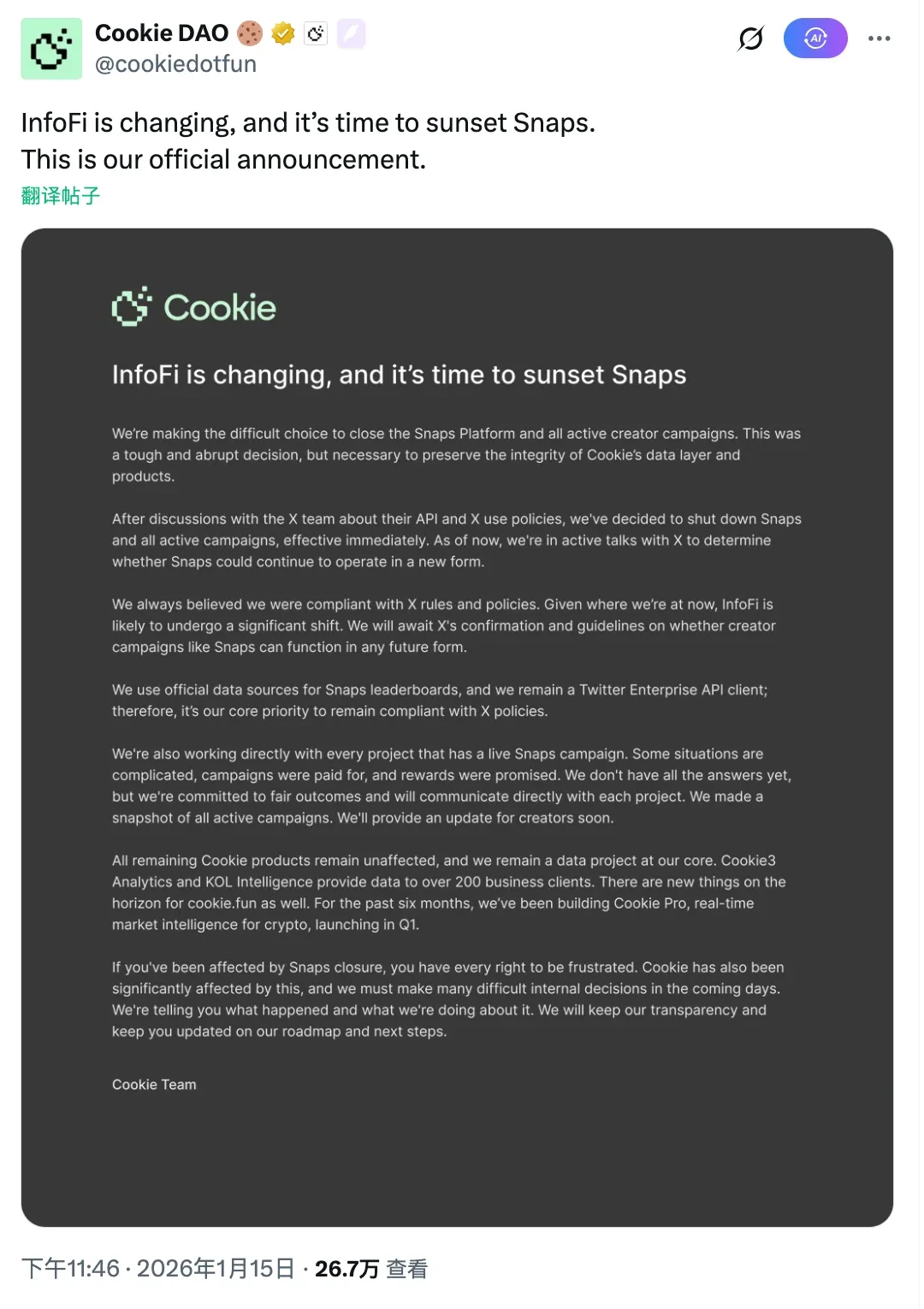
Judging from the wording, Snaps’ shutdown appears more like a defensive move to limit losses under sudden impact. On one hand, Cookie stressed that it always used official data sources and remains an enterprise-level API client of X. On the other, the team openly stated that InfoFi is undergoing structural change, and whether Snaps can exist in a “new form” depends on further guidance from X. This language itself signals deep uncertainty about the sustainability of the original incentive model.
By contrast, Kaito’s adjustment was more proactive. Kaito announced the shutdown of Yaps and its incentive leaderboards, while launching Kaito Studio, explicitly bidding farewell to the “open, permissionless incentive distribution” path. According to official statements, Kaito Studio will resemble a more traditional tiered marketing platform, where brands select creators based on predefined standards. Platform coverage will also expand beyond X to include YouTube, TikTok, and other social channels.

In explaining the shift, Kaito did not avoid the inherent issues of the InfoFi model. It noted that even with higher thresholds and screening mechanisms, low-quality content and farming behavior remained difficult to eliminate. After discussions with X, the team agreed that a “fully permissionless incentive distribution system” no longer aligns with the shared needs of platforms, brands, and creators. Reading between the lines, the end of Yaps appears to be a deliberate abandonment of the original InfoFi route.
Taken together, these cases point to a clear trend: once platforms tighten API access and incentive boundaries, InfoFi projects must either pause aggressive incentive strategies and revert to data and tooling roles, or fully reconstruct their business logic toward models closer to traditional marketing and content partnerships.
For now, while token prices fluctuate, a collective collapse of InfoFi projects has not occurred. What is clear, however, is that the model of relying on platform APIs and using external incentives to directly drive posting and interaction has become extremely difficult to sustain.
CONCLUSION: THE TALKING-TO-EARN ERA IS OVER, BUT INFOFI’S QUESTIONS REMAIN
The responses from InfoFi projects suggest this shift is not simply a “ban” or a failure. Whether Cookie’s return to a data-layer focus or Kaito’s move toward a Studio model closer to traditional marketing, both indicate that InfoFi has not disappeared—it simply can no longer exist as “in-platform incentive arbitrage.”
When people say “the talking-to-earn era is over,” what has ended is not the quantification of content or the pricing of influence, but the open incentive pathway that relies on APIs and treats posting and replying themselves as settlement objects. As platforms reassert sovereignty, the room for this model is rapidly shrinking.
As for migration to Threads or Bluesky, that appears more like a temporary buffer than a real solution. The deeper question is whether InfoFi can still find an irreplaceable role without taking over platforms’ content production rights.
X may be the first platform to press the button, but the signal it has sent is unmistakable: content sovereignty is returning to the platforms themselves.