








KEYTAKEAWAYS
- The MEMES rally was primarily sentiment-driven, sparked by social amplification rather than fundamentals, with on-chain data showing rapid wallet churn and high turnover instead of sustained accumulation.
- Incentive structures such as the BNB Chain USD1 trading competition significantly magnified trading volume and visibility, converting short-term attention into measurable on-chain activity.
- The episode highlights a structural feature of meme markets in 2026, where attention functions as liquidity and price discovery is driven by reflexive coordination rather than long-term value creation.

CONTENT
A single repost triggered a speculative surge on BNB Chain as the MEMES token soared over 280× intraday, illustrating how social signals, on-chain incentives, and shallow liquidity can rapidly turn attention into extreme volatility.
THE SPARK
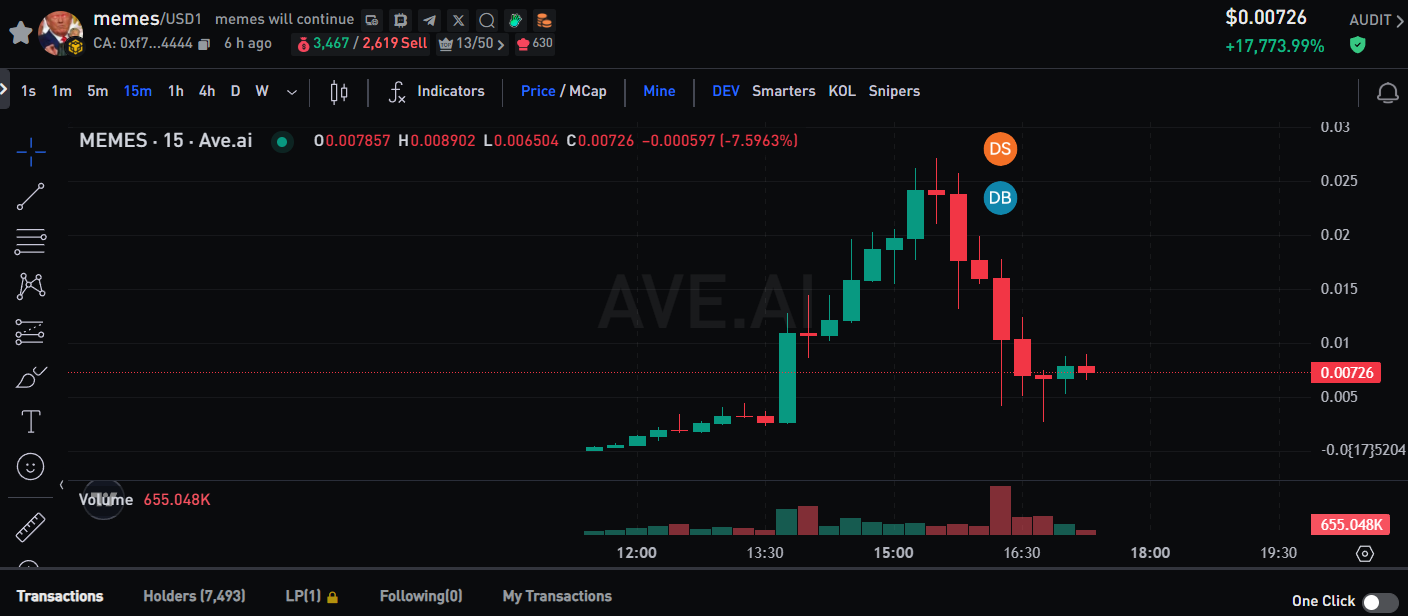
On January 21, a little-noticed meme token called MEMES on the BNB Chain became the center of one of the most extreme short-term rallies seen in recent months, after a repost by He Yi, combined with a rare and widely circulated White House social media post referencing “memes,” abruptly pushed the asset from obscurity into global crypto discourse, triggering a rapid influx of speculative capital that sent its price surging by more than 280× intraday and briefly lifted its market capitalization above $18 million, according to real-time tracking data from GMGN and BNB Chain explorers.
On-chain records show that MEMES was deployed and primarily traded on BNB Chain, with its liquidity concentrated in pools indexed by GMGN and visible on BscScan, and within hours of the repost its 24-hour trading volume expanded to approximately $37.9 million, a figure that far exceeded its early liquidity base and underscored how quickly attention-driven flows can overwhelm shallow order books when social amplification and narrative alignment converge.
ON-CHAIN MECHANICS
What distinguished the MEMES episode from routine meme volatility was not merely the price movement, but the speed at which on-chain metrics re-priced risk, as liquidity migrated aggressively into MEMES pools and turnover ratios spiked, indicating that capital was rotating rapidly rather than accumulating with long-term conviction, a pattern that is clearly observable in block-by-block transaction data on BscScan, where bursts of high-frequency swaps dominated activity during peak momentum windows.
According to GMGN monitoring, MEMES experienced a sharp “wick down” to roughly $14.29 million in market value during a brief liquidity vacuum, before rebounding above $18 million, a sequence that illustrates how meme markets often oscillate between euphoria and fragility within minutes, especially when price discovery is driven less by fundamentals and more by reflexive trading behavior amplified by social cues.
THE USD1 EFFECT
Momentum intensified further when MEMES qualified for the BNB Chain USD1 Trading Competition, a ten-day incentive program that ranks meme tokens by market capitalization and trading activity, provided they maintain active USD1-denominated liquidity pools, a condition that MEMES met shortly after launch, allowing it to enter the competition’s top tier alongside other high-beta meme assets.
By mid-day, GMGN data showed MEMES had climbed to an estimated $23 million market capitalization, with a quoted price near $0.023, placing it among the top three meme tokens in the USD1 competition by market value, while simultaneously ranking first by 24-hour trading volume, a convergence that highlights how incentive structures can magnify speculative flows by converting short-term attention into measurable on-chain activity.
SOCIAL SIGNALS AND CROWD DYNAMICS
The catalytic role of He Yi’s repost is less about authority endorsement and more about signaling, because in meme markets credibility is often inferred through proximity to recognized figures rather than explicit validation, and the repost acted as a coordination point for traders already primed by the White House’s viral phrasing, effectively synchronizing attention across retail channels.
This synchronization is visible in wallet-level data, where clusters of new addresses entered the MEMES pools shortly after the repost, a pattern consistent with retail-driven participation rather than concentrated whale accumulation, reinforcing the view that the rally was primarily sentiment-led, with capital cycling rapidly through positions rather than settling into longer-term holdings.
A BROADER MEME CYCLE ON BNB CHAIN
The MEMES surge did not occur in isolation but within a broader resurgence of meme activity on BNB Chain, where lower transaction costs and fast block times continue to attract speculative traders, particularly when combined with competitive incentives such as the USD1 trading program, which effectively gamifies liquidity provision and turnover rather than usage or utility.
Historical comparisons on CoinMarketCap and BNB Chain analytics suggest that such meme-driven bursts tend to peak quickly once attention disperses or incentives rotate, yet they also serve as stress tests for on-chain infrastructure and liquidity design, revealing how rapidly capital can mobilize when narrative catalysts, social amplification, and incentive alignment coincide.
INTERPRETATION
From a structural perspective, the MEMES episode reinforces a familiar but often underestimated reality of on-chain markets: attention is a form of liquidity, and when attention is compressed into a narrow time window by social signals, even tokens with no intrinsic utility can temporarily absorb tens of millions of dollars in volume, provided the execution environment is frictionless and incentives are aligned.
At the same time, on-chain transparency makes the risks equally visible, as wallet churn, liquidity concentration, and rapid drawdowns are all traceable in real time, offering a reminder that meme rallies are less about value creation and more about reflexive coordination, where gains and losses are redistributed at speed rather than accumulated sustainably.
CONCLUSION
The explosive rise of MEMES on BNB Chain, catalyzed by a single high-profile repost and amplified by incentive-driven liquidity programs, illustrates how modern meme markets operate at the intersection of social signaling, on-chain mechanics, and speculative reflexivity, producing short-lived but intense price discovery events that are fully observable, verifiable, and repeatable under similar conditions.
While MEMES itself may or may not retain relevance once attention shifts, the episode underscores a broader truth about crypto markets in 2026: narratives move faster than fundamentals, incentives accelerate behavior, and on-chain data provides a transparent record of how quickly collective sentiment can turn visibility into volatility.
Read More:
When Prediction Becomes Infrastructure: How Probable Markets Is Positioning Itself Inside BNB Chain