







KEYTAKEAWAYS
- Ethereum accounts for roughly 65–70% of total DeFi TVL, with over $70 billion locked on-chain—nearly nine times the size of the next-largest Layer-1 ecosystem.
- The concentration of TVL reflects where risk-sensitive capital prefers to settle, prioritizing security history, composability, and liquidity depth over raw performance.
- As DeFi matures, capital appears to be reconsolidating around Ethereum as the core financial infrastructure, signaling a structural rather than cyclical shift.

- KEY TAKEAWAYS
- DEFI CAPITAL IS RECONCENTRATING AROUND ETHEREUM
- WHY TVL CONCENTRATION MATTERS MORE THAN NARRATIVE SHARE
- FINANCIAL GRAVITY AND THE ROLE OF SETTLEMENT LAYERS
- LAYER 2 SCALING HAS ALTERED ETHEREUM’S COST STRUCTURE
- WHY COMPETITION HAS NOT DISPLACED THE CORE
- FROM EXPANSION TO RECONSOLIDATION
- A STRUCTURAL, NOT CYCLICAL, SIGNAL
- DISCLAIMER
- WRITER’S INTRO
CONTENT
Ethereum’s growing share of DeFi TVL highlights a structural reconcentration of capital, reinforcing its role as the primary settlement layer for decentralized financial markets.
DEFI CAPITAL IS RECONCENTRATING AROUND ETHEREUM
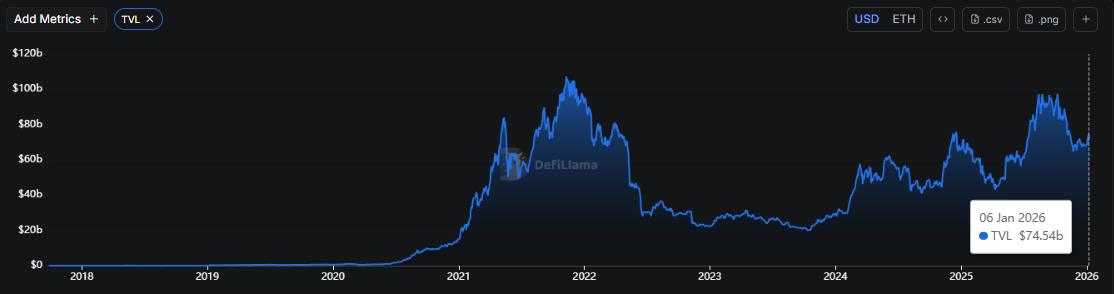
Recent on-chain data confirms a renewed concentration of decentralized finance activity on Ethereum, reinforcing its role as the primary settlement layer for on-chain financial markets. According to DeFiLlama, Ethereum’s DeFi total value locked (TVL) stands at over USD 70 billion, accounting for approximately 65–70% of total DeFi TVL across public blockchains, depending on the measurement window.
By comparison, the next-largest Layer-1 ecosystems—such as Solana, BNB Chain, and Bitcoin-based DeFi—each account for single-digit percentage shares, placing Ethereum’s TVL at roughly nine times the size of the second-largest Layer-1 network. This widening gap marks a decisive reassertion of dominance following several years of multi-chain experimentation.
WHY TVL CONCENTRATION MATTERS MORE THAN NARRATIVE SHARE
TVL concentration is widely treated as a proxy for where risk-sensitive capital chooses to reside. Unlike transaction counts or wallet activity, DeFi TVL represents capital actively exposed to smart-contract risk, liquidation mechanisms, and collateral design.
Industry analysis cited by Cointelegraph and Cryptopolitan shows that while DeFi activity has expanded across multiple networks, capital involved in lending, stablecoin liquidity, and leveraged strategies has increasingly gravitated back toward Ethereum. This pattern suggests that, when financial exposure increases, capital prioritizes environments with longer operational histories, deeper liquidity pools, and more mature security tooling.
FINANCIAL GRAVITY AND THE ROLE OF SETTLEMENT LAYERS
The concept of financial gravity describes the tendency of capital to cluster around infrastructure that minimizes uncertainty during periods of stress. In traditional finance, this role is played by clearinghouses and systemically important settlement networks. In decentralized finance, Ethereum has increasingly assumed a comparable function.
Core DeFi primitives—money markets, decentralized stablecoins, derivatives, and collateralized lending—remain most liquid and interconnected on Ethereum. This composability allows capital to move between protocols without crossing trust boundaries, reducing friction for large positions and complex strategies.
LAYER 2 SCALING HAS ALTERED ETHEREUM’S COST STRUCTURE
One factor reinforcing Ethereum’s position is the maturation of its Layer-2 ecosystem. Rollups have absorbed a growing share of transactional activity while anchoring security to Ethereum’s base layer. As a result, Ethereum’s DeFi dominance is no longer synonymous with high execution costs alone.
According to ecosystem-wide tracking, a significant portion of user activity now occurs on Ethereum-secured rollups, while liquidity and settlement finality remain anchored to Ethereum itself. This modular architecture allows scalability without fragmenting capital across incompatible execution environments.
WHY COMPETITION HAS NOT DISPLACED THE CORE
Alternative Layer-1 networks continue to demonstrate strengths in throughput, latency, and user experience, and many host active DeFi ecosystems. However, recent TVL data shows that these advantages have not translated into sustained displacement at the core financial layer.
For capital prioritizing risk management over experimentation, fragmentation introduces costs—bridging risk, liquidity isolation, and reduced composability—that outweigh performance gains. As position sizes grow and protocol interdependence increases, these trade-offs become more pronounced.
FROM EXPANSION TO RECONSOLIDATION
The current TVL distribution suggests that DeFi is transitioning from an expansion phase, characterized by rapid chain proliferation, into a reconsolidation phase, where capital selectively returns to infrastructures best suited for financial settlement rather than application experimentation.
Ethereum’s dominance in this phase does not imply the end of multi-chain innovation. Instead, it highlights a functional separation: experimentation may occur across many networks, but financial gravity continues to pull core capital toward Ethereum.
A STRUCTURAL, NOT CYCLICAL, SIGNAL
Viewed through a structural lens, Ethereum’s DeFi dominance reflects infrastructure selection rather than short-term market cycles. As decentralized finance matures, capital appears increasingly unwilling to compromise on settlement guarantees, composability, and security history.
The latest TVL data serves as confirmation rather than surprise: when meaningful financial exposure is at stake, decentralized capital continues to converge where financial gravity is strongest.
Read More:
Ethereum: The Pivotal Settlement Network for Global Stablecoin Liquidity