








KEYTAKEAWAYS
-
Multi chain DeFi did not fail because of liquidity or leverage. It failed because traders were forced to manage chains, gas, and execution paths. Vooi’s chain abstracted account model removes this burden by design, not by education.
-
By letting users sign desired results instead of execution paths, Vooi moves complexity and execution risk away from traders. This aligns on chain trading with how markets are actually used, not how blockchains are built.
-
Gasless execution, smart contract accounts, and session based actions allow Vooi to feel less like a crypto tool and more like a modern trading app. This changes who DeFi is built for, not just how it looks.

- KEY TAKEAWAYS
- MULTI CHAIN EXPANSION CREATED A COST MOST PRODUCTS PRETEND DOES NOT EXIST
- A UNIFIED ACCOUNT MODEL WHERE THE CHAIN NO LONGER DEFINES CAPABILITY
- INTENT BASED TRADING SHIFTS EXECUTION RISK AWAY FROM THE USER
- ACCOUNT ABSTRACTION AND GASLESS DESIGN PUSH DEFI TOWARD MAINSTREAM UX
- DISCLAIMER
- WRITER’S INTRO
CONTENT
For years, the crypto industry framed multi chain expansion as progress. New Layer 2 networks launched. New app specific chains emerged. Throughput increased and execution became faster. On the surface, everything pointed forward. Yet for users, especially traders, the experience quietly moved in the opposite direction.
Nowhere is this tension clearer than in perpetual trading. It is a market defined by timing, capital efficiency, and execution speed. But on chain, traders often lose not because their market view is wrong, but because their assets sit on the wrong network. Capital is fragmented across chains. Operations are slowed by bridges and approvals. Attention is consumed by gas balances and network switches.
Vooi enters this landscape with a blunt premise. If users must think about blockchains every time they trade, DeFi will never move beyond a narrow audience. Trading should be about decisions, not infrastructure. Everything else is friction.
MULTI CHAIN EXPANSION CREATED A COST MOST PRODUCTS PRETEND DOES NOT EXIST
On chain perpetual markets look increasingly competitive on paper. Liquidity is deeper. Fees are lower. Market structures are more mature. But these surface metrics hide a cost that traders feel every day and dashboards rarely capture.
Capital fragmentation is the first problem. A trader may have sufficient funds overall, but not enough on the specific chain where an opportunity appears. Moving capital takes time and introduces uncertainty. In fast markets, that delay alone can invalidate a trade.
Operational friction compounds the issue. A single trade can involve swaps, approvals, bridges, confirmations, and network changes. Each step adds cognitive load. Each step introduces the chance of failure. Over time, this friction reshapes behavior. Traders hesitate. They trade less. They avoid complexity even when opportunity exists.
Gas management adds another silent tax. Users must hold native tokens across multiple networks simply to remain functional. Running out of gas at the wrong moment does not just slow execution. It removes the ability to act at all.
None of this improves trading outcomes. It only drains attention. Vooi treats this friction as a structural flaw rather than a user responsibility. Instead of teaching users how to manage complexity, it aims to remove complexity from the experience entirely.

A UNIFIED ACCOUNT MODEL WHERE THE CHAIN NO LONGER DEFINES CAPABILITY
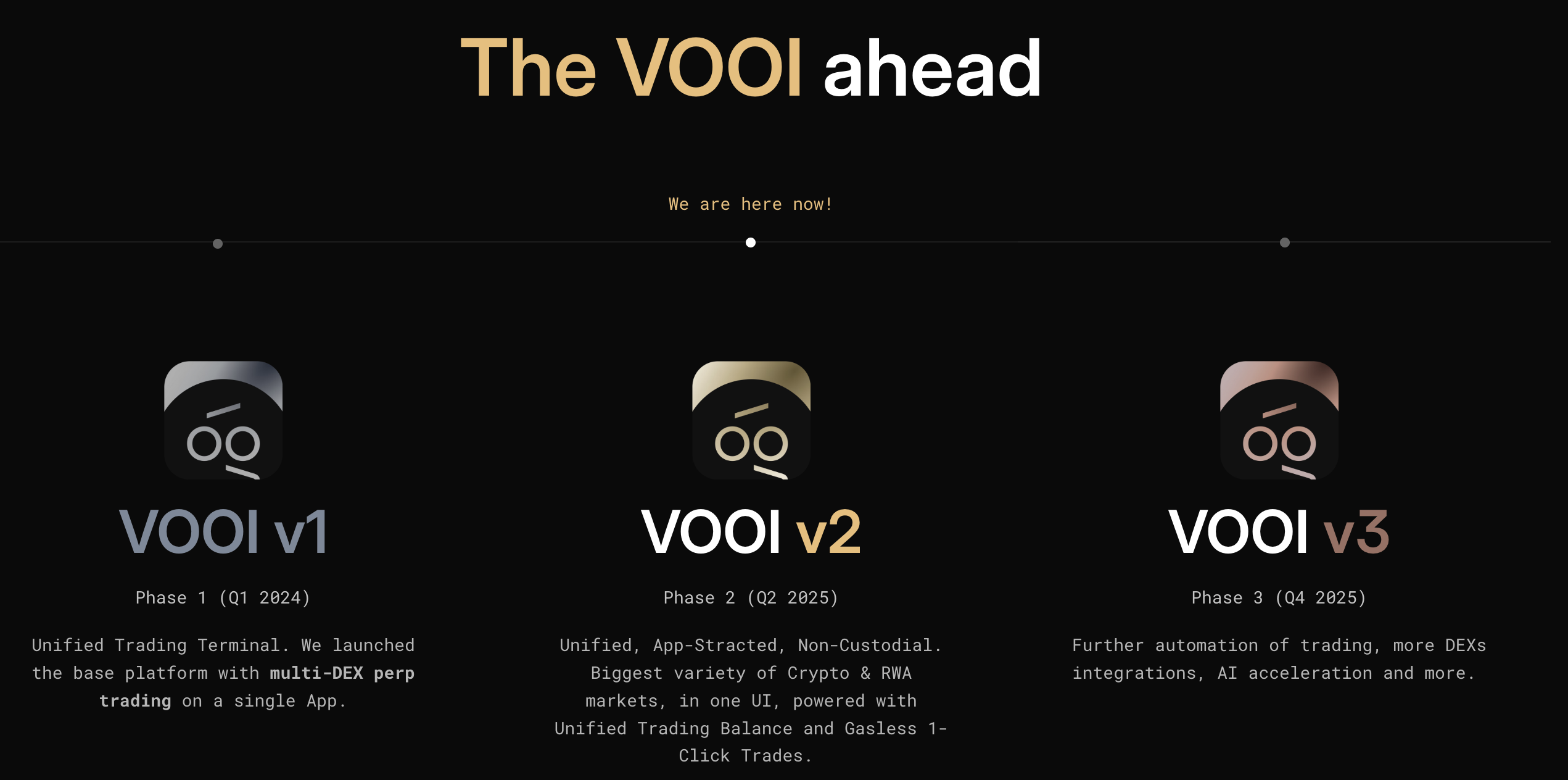
The most important change in Vooi V2 is not a feature. It is a shift in how an account is defined.
Traditional DeFi accounts are inseparable from the chain they live on. Where assets sit determines what a user can do. In a multi chain world, this model collapses into inefficiency. Real capital becomes fragmented into isolated pools that cannot easily work together.
Vooi introduces a chain abstracted account model. Assets deposited across different networks are represented as a single usable balance at the interface level. The user does not choose a chain. The system handles that logic internally.
When a trade is placed, liquidity routing and settlement occur in the background. The user does not bridge funds manually. Capital does not need to be pre positioned. The experience centers on the account rather than the network.
This design reassigns responsibility. Cross chain complexity moves upstream into the system. Chains still exist, but they no longer dictate how users interact with the product. The account becomes the primary abstraction.
Vooi is not competing to build a faster bridge. It is trying to make the concept of bridging irrelevant from the user’s point of view.
INTENT BASED TRADING SHIFTS EXECUTION RISK AWAY FROM THE USER
Even with unified balances, traditional on chain trading still forces users to manage execution details. Users sign transactions that define exact paths and contract calls. When conditions change mid execution, the user absorbs the risk.
Vooi approaches execution differently. It uses an intent based trading model. Instead of signing how a trade should be executed, the user signs what outcome they want. Price bounds, position direction, and constraints are defined upfront.
Once the intent is submitted, execution is handled by a solver network. Participants compete to fulfill the intent under the given conditions. The system selects the best result rather than forcing the user to manage the process.
This changes the trader’s role. The user focuses on decisions. The system handles execution. Risk tied to path dependency and timing is reduced because outcomes are locked at the intent level.
It also reduces exposure to common on chain risks such as frontrunning and inefficient gas usage. More importantly, it aligns the trading experience with how people already think about markets. Traders care about results, not contract calls.
This is a subtle shift, but a meaningful one. It moves DeFi closer to outcome driven trading instead of process driven interaction.
ACCOUNT ABSTRACTION AND GASLESS DESIGN PUSH DEFI TOWARD MAINSTREAM UX
The final barrier for most users has always been the account itself. Wallet setup, gas management, and signing flows are familiar to crypto natives, but alien to everyone else.
Vooi Light is built on account abstraction. Users interact through smart contract accounts rather than externally owned accounts. Gas is paid by the system and settled in stable assets. Users do not need to hold native tokens or understand fee mechanics.
Login flows reduce friction further. Session keys allow repeated actions without constant signing. On mobile and messaging platforms, this design removes the mental overhead that usually defines DeFi usage.
The result is not just convenience. It changes who the product is built for. Vooi does not assume users want to become blockchain experts. It assumes they want to trade.
When chains are hidden, gas is invisible, and accounts behave like modern financial apps, DeFi begins to look less like an experimental toolkit and more like a usable system. Vooi is not simply aggregating liquidity. It is competing for the entry point. And in DeFi, the entry point often matters more than the protocol underneath.
Read More:
What is VOOI ($VOOI)? A perpetual DEX aggregator with Chain Abstraction
VOOI: Intent-Based Trading Across Multiple Perp DEXs at Your Fingertips