









KEYTAKEAWAYS
- Turkmenistan has legalized crypto mining and authorized state-regulated exchanges, signaling a strategic shift rather than broad financial liberalization.
- The move reflects an effort to convert surplus energy into globally transferable digital value while maintaining centralized oversight.
- This top-down, state-managed approach suggests that future crypto adoption may increasingly be driven by national economic constraints rather than market-led decentralization.

- KEY TAKEAWAYS
- A RARE POLICY REVERSAL IN ONE OF THE WORLD’S MOST CLOSED ECONOMIES
- FROM PROHIBITION TO CONTROLLED ADOPTION
- ENERGY SURPLUS AND THE SEARCH FOR VALUE EXPORTS
- CRYPTO AS A STATE-LEVEL FINANCIAL INTERFACE
- A SIGNAL FOR STATE-DRIVEN CRYPTO ADOPTION
- FROM ANOMALY TO EMERGING PATTERN
- DISCLAIMER
- WRITER’S INTRO
CONTENT
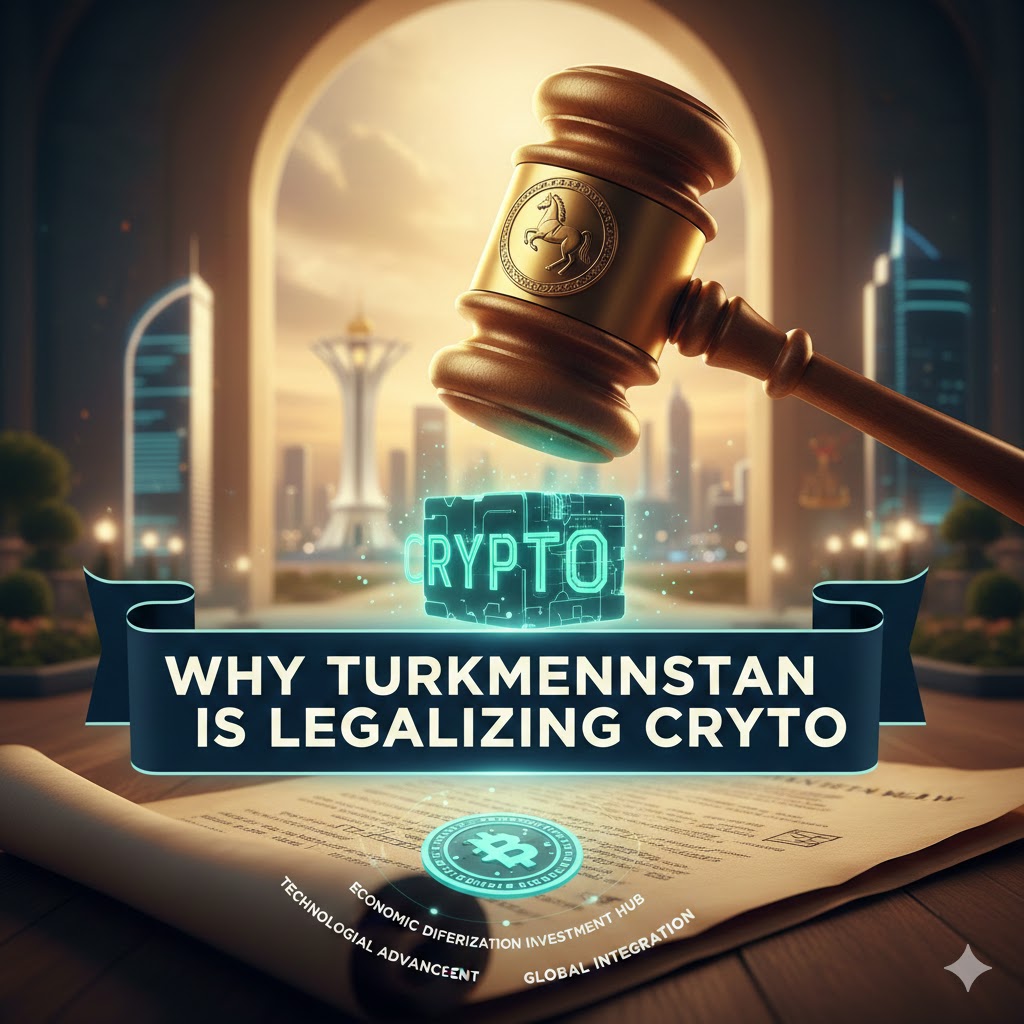
Turkmenistan’s decision to legalize crypto mining and state-regulated exchanges marks a rare policy reversal in one of the world’s most closed economies, revealing how digital assets are being adopted as controlled economic infrastructure rather than open financial systems.
A RARE POLICY REVERSAL IN ONE OF THE WORLD’S MOST CLOSED ECONOMIES
In early 2026, Turkmenistan quietly introduced one of the most unexpected crypto policy shifts of the year: the legalization of cryptocurrency mining and the authorization of state-regulated crypto exchanges. For a country long regarded as one of the most economically and politically closed systems in the world, the move represents more than regulatory experimentation—it signals a structural reassessment of how digital assets can serve national economic objectives.
According to reporting by AP News, the new framework allows crypto mining operations to operate legally under licensing rules and establishes exchange activity overseen by state authorities. While cryptocurrencies are not recognized as legal tender, the policy explicitly permits controlled participation in crypto infrastructure, marking a sharp departure from years of tight restrictions on capital movement and financial innovation.
FROM PROHIBITION TO CONTROLLED ADOPTION
Historically, Turkmenistan has maintained strict controls over currency exchange, capital flows, and internet access, limiting exposure to global financial systems. Against this backdrop, the legalization of crypto activity stands out as a rare policy reversal rather than an incremental adjustment.
The regulatory design is telling. Instead of open market liberalization, the government has opted for state-licensed mining and centrally supervised exchanges, indicating that crypto is being adopted not as a decentralized alternative, but as a managed economic instrument. This approach mirrors how the country has historically handled strategic sectors such as energy and telecommunications—open enough to extract value, but structured to retain oversight.
ENERGY SURPLUS AND THE SEARCH FOR VALUE EXPORTS
One of the clearest drivers behind the policy shift lies in Turkmenistan’s economic structure. The country possesses some of the world’s largest natural gas reserves, yet faces persistent challenges in monetizing excess energy due to infrastructure constraints and limited access to international financial channels.
Crypto mining offers a mechanism to convert surplus energy into a globally transferable digital asset, bypassing some of the logistical and geopolitical frictions associated with traditional energy exports. By legalizing mining under a licensing regime, the state can channel excess electricity into revenue generation while maintaining visibility over operators and output.
This energy-to-value logic has previously emerged in other resource-rich regions, but Turkmenistan’s adoption is notable because it comes from a government historically resistant to financial openness.
CRYPTO AS A STATE-LEVEL FINANCIAL INTERFACE
Beyond mining, the authorization of regulated exchanges suggests a broader objective: establishing a controlled interface between domestic economic activity and global digital markets. In an environment where foreign currency access is constrained and cross-border settlement options are limited, crypto infrastructure can function as a supplementary channel for value transfer—without requiring full integration into traditional banking systems.
Importantly, the framework does not decentralize monetary control. Instead, it introduces crypto as an auxiliary system, operating alongside existing financial structures rather than replacing them. This distinction helps explain why the policy could be politically viable in a highly centralized system.
A SIGNAL FOR STATE-DRIVEN CRYPTO ADOPTION
Turkmenistan’s move challenges a common assumption in crypto discourse—that adoption is driven primarily by market liberalization or grassroots demand. In this case, adoption is top-down, strategic, and tightly regulated, shaped by national economic constraints rather than ideological alignment with decentralization.
For the broader crypto industry, the implication is significant: future adoption may increasingly come from states seeking pragmatic tools to manage energy, liquidity, and external connectivity, rather than from purely open financial environments.
FROM ANOMALY TO EMERGING PATTERN
While Turkmenistan remains an outlier, its policy shift fits into a broader global trend in which governments are reframing crypto not as a speculative asset class, but as infrastructure capable of serving specific economic functions. In this context, legalization does not necessarily signal openness—it signals utility.
As more countries reassess how digital assets can be integrated into tightly controlled economic systems, Turkmenistan’s experiment may serve as an early case study in state-managed crypto adoption, where control and functionality take precedence over ideological decentralization.
Read More:
CRYPTO TAX TRANSPARENCY BECOMES A GLOBAL INFRASTRUCTURE ISSUE
GLOBAL CRYPTO REGULATION EVOLVES INTO IMPLEMENTATION IN 2026