




KEYTAKEAWAYS
- Prediction market odds of a late-January U.S. government shutdown have fallen sharply, signaling reduced confidence in a full shutdown scenario.
- The funding dispute has evolved into a midterm-election-driven political battle rather than a simple budget fight.
- With electoral risks rising, both parties are increasingly incentivized to pass a temporary funding solution and delay deeper conflicts.

CONTENT
U.S. government shutdown risks have eased as political incentives tied to the midterm elections push both parties toward compromise, with prediction markets signaling declining odds of a late-January shutdown.
BUY-AND-HOLD STRATEGY SPARKS DEBATE AS CZ ACCUSES COMMUNITY OF COORDINATED ATTACKS
One major macro issue this month is whether the U.S. government will shut down at the end of January. In October last year, the government was shut down for 43 days and only resumed operations after a temporary funding bill was passed. That temporary measure expires on January 30. If Congress fails to pass a full appropriations bill or extend another stopgap, the government will shut down again.
This time, the core dispute between Democrats and Republicans centers on funding for the Department of Homeland Security (DHS). Democrats argue that Immigration and Customs Enforcement (ICE) conducted problematic enforcement actions in Minnesota that resulted in two deaths, and they want to impose strict limits on funding and related operations. Republicans reject this view, maintaining that ICE is essential for combating illegal immigration and welfare fraud. As a result, the two sides remain deadlocked.
This standoff, combined with the approaching expiration of the temporary funding bill, pushed prediction market odds of a late-January government shutdown sharply higher. However, Polymarket data this morning shows those odds have continued to decline, now falling to 42%, down from a previous peak of around 80%.
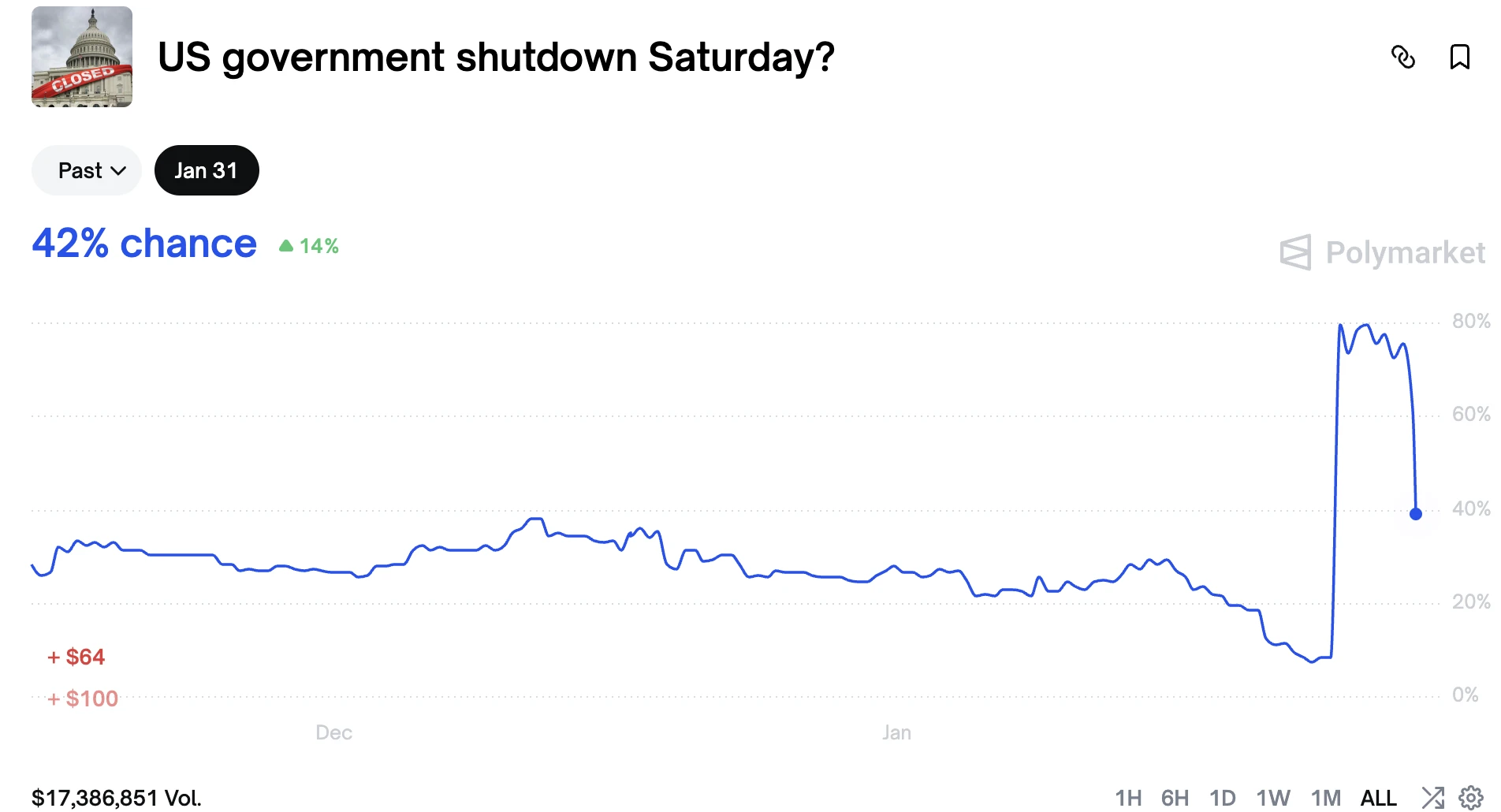
Price movements in prediction markets reflect the outcome of collective intelligence at work. The rising probability that the U.S. government will not shut down at the end of January suggests that, under the current political conditions, the previously high confidence implied by prediction market odds for a shutdown has faded.
>>> More to read: What is Crypto Prediction Market?
THE MIDTERM ELECTIONS ARE THE REAL PRIORITY FOR BOTH U.S. PARTIES
On January 28, amid renewed concerns that the U.S. government could face another shutdown, Treasury Secretary Bessent said the situation remains uncertain, while emphasizing that President Trump has urged Democrats to avoid such an outcome.
At its core, this shutdown risk stems from Republicans being put on the defensive by a political counteroffensive from Democrats. The January 24 shooting death of a U.S. citizen by ICE enforcement officers in Minnesota was a direct consequence of the Trump administration’s tougher immigration enforcement stance. The incident triggered large-scale public protests and growing dissatisfaction with the administration. Democrats seized this moment, using the case as justification to block the passage of the funding bill in the Senate. Because this stance aligns with voter sentiment, Democrats have gained the political upper hand in this confrontation.
As a result, Republicans now find themselves in a passive position. If a government shutdown were to occur, the resulting economic and social disruptions—such as delayed economic data releases and widespread flight delays—could easily be blamed on Republican governance failures by Democrats.
These potential chain reactions directly affect what both parties truly care about this year: the U.S. midterm elections.
Midterm elections are held in the second year of a presidential term. All 435 seats in the House of Representatives are up for election, along with roughly one-third of the Senate seats. Currently, Republicans hold majorities in both chambers, with 218 seats in the House and 53 in the Senate. To maintain these advantages after the midterms and reduce resistance to governance, Republicans cannot afford to accumulate too many political liabilities this year.
Although the midterms do not involve the presidency itself, they are widely viewed as a “midterm referendum” on the sitting president. The results influence policy direction for the remainder of the term, reshape internal party power dynamics, and help define the field for the next presidential election. For Trump personally, the stakes are therefore extremely high.
Viewed through this lens, the current shutdown threat is no longer a simple dispute over appropriations. It has become a political battleground carefully laid out in advance of the midterm elections. Given their disadvantaged position, Republicans are highly likely to compromise in order to defuse the crisis.
For Democrats, any such compromise would represent a clear political victory.
COMPROMISE IS ALREADY UNDERWAY
This round of the U.S. government shutdown risk is unlikely to resemble last October’s full-scale shutdown, when all 12 appropriations bills expired at once. The potential scope this time is much smaller. Funding for the Department of Commerce (which releases GDP and other key data) and the Department of Agriculture (which oversees food assistance programs) has already been secured. However, roughly 78% of federal government functions—covered by the remaining six appropriations bills—could still face a funding lapse.
In practice, Democrats have already offered Republicans a way out. On January 28, Senate Minority Leader Chuck Schumer (D–New York) said Senate Democrats were “prepared to move quickly before the January 30 deadline on five appropriations bills, separating them from the Department of Homeland Security (DHS) funding bill.” This approach could help avoid a large-scale government shutdown. So far, however, Senate Republicans have not agreed to split DHS funding from the broader package.
At the same time, revising DHS funding before January 30 is unrealistic. Any changes to the remaining six appropriations bills would require approval from the House of Representatives, which will not reconvene until February 2.
For Democrats, pushing too hard to amend the funding bills at the cost of triggering a shutdown would bring limited benefits and could even reverse the current political momentum between the two parties. As a result, the emerging consensus in Washington appears to be passing another short-term continuing resolution to prevent a shutdown first, while postponing deeper partisan disputes.
The New York Times has also reported that President Trump is in talks with Chuck Schumer on a possible deal to avert a government shutdown.
According to two officials familiar with the discussions, the plan under consideration would have the Senate separate one of the six spending bills—specifically the one funding the Department of Homeland Security—while passing the others to keep the military, healthcare programs, and other federal agencies funded for the rest of the fiscal year. The Senate aims to approve these measures before the Friday midnight deadline, while Congress would also consider a short-term extension of DHS operations to prevent disruptions to the Transportation Security Administration, the Coast Guard, and the Federal Emergency Management Agency.
While it remains unclear how this potential agreement will affect this week’s appropriations votes, it at least signals that both the White House and the Senate are actively working toward de-escalating the crisis.