




KEYTAKEAWAYS
- Citigroup expects the Bank of Japan could raise rates up to three times in 2026 if the yen remains weak, potentially doubling the current policy rate.
- Persistent negative real interest rates are increasingly viewed as the core driver of yen depreciation, elevating currency stability as a key policy priority.
- A more aggressive BOJ tightening cycle could reshape global capital flows by reducing yen-funded carry trades and increasing volatility across risk assets.

CONTENT
Citigroup warns that persistent yen weakness could force the Bank of Japan into multiple rate hikes in 2026, signaling a potential structural shift in Japan’s monetary stance.
A SHIFT IN EXPECTATIONS
In late January 2026, market expectations around Japan’s monetary policy took a notable turn after senior executives at Citigroup publicly suggested that persistent yen weakness could force the Bank of Japan into a significantly more aggressive rate-hiking cycle than investors had previously anticipated, potentially raising rates as many as three times within the year and effectively doubling the current policy rate, a scenario that would mark a sharp departure from Japan’s decades-long reputation for ultra-loose monetary conditions.
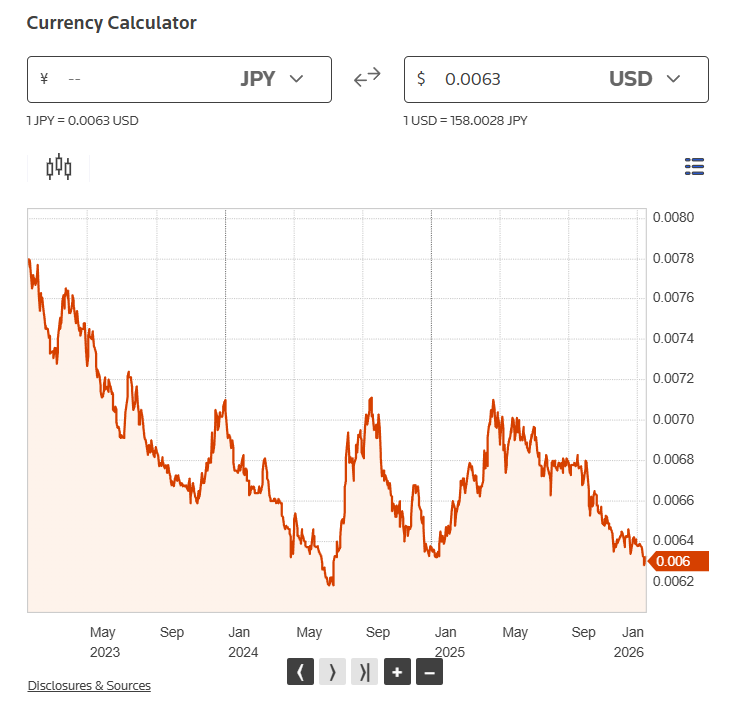
Akira Hoshino, head of Japan markets at Citigroup, stated in interviews that if the U.S. dollar–yen exchange rate were to break above the 160 level and remain there, the Bank of Japan could respond as early as April with a 25-basis-point hike in the uncollateralized overnight call rate to around 1%, with further hikes in July and potentially later in the year if currency pressures fail to ease, a path that would place exchange-rate stability at the center of Japan’s policy reaction function rather than domestic growth alone.
THE YEN PROBLEM
The yen’s prolonged weakness has increasingly become a macroeconomic constraint rather than a mere byproduct of global rate differentials, particularly as Japan’s real interest rates remain deeply negative when adjusted for inflation, creating persistent downward pressure on the currency even as other major central banks have either paused or begun cautiously easing policy.
Hoshino’s assessment frames the issue bluntly: yen depreciation is fundamentally driven by negative real rates, and without addressing that imbalance, verbal intervention or incremental policy tweaks are unlikely to produce durable exchange-rate stabilization, a view echoed by a growing number of global banks that now see currency defense, rather than domestic demand management, as the primary catalyst for further normalization by the Bank of Japan.

A DIFFERENT KIND OF TIGHTENING
Unlike rate hikes in the United States or Europe, which are typically framed around inflation control or labor-market overheating, prospective tightening by the Bank of Japan would represent a structural recalibration of Japan’s role in global capital flows, because higher domestic rates would reduce incentives for yen-funded carry trades that have long fueled risk-taking across global bond, equity, and emerging-market assets.
If the policy rate were to rise toward or above 1% through multiple hikes, as Citigroup’s scenario suggests, the resulting repricing of Japanese yields could trigger capital repatriation, raise funding costs for leveraged global strategies, and alter correlations that markets have relied on for years, particularly at a time when global liquidity conditions remain fragile and sensitive to policy surprises.
MARKET IMPLICATIONS
Currency markets have already begun to price a wider trading range for the yen, with Citigroup projecting fluctuations between the high-140s and mid-160s against the dollar in 2026, a range that reflects both uncertainty over U.S. monetary policy and the conditional nature of Bank of Japan tightening tied explicitly to exchange-rate thresholds rather than a fixed policy calendar.
For global investors, this conditionality introduces a new layer of risk, as sudden currency moves could now prompt policy action rather than merely rhetorical responses, increasing volatility across rates, equities, and cross-asset positioning, while also raising the possibility that Japan, long viewed as a source of excess liquidity, could gradually become a contributor to global tightening pressures instead.
A STRUCTURAL TURN
The significance of Citigroup’s warning lies less in the precise number of hikes and more in what it reveals about shifting priorities at the Bank of Japan, where exchange-rate credibility and real-rate normalization appear to be gaining weight relative to growth accommodation, signaling that Japan’s exit from extraordinary monetary policy may be driven as much by external pressures as by domestic conditions.
If realized, a three-hike scenario in 2026 would not simply mark another incremental step toward normalization, but would represent a structural turning point in Japan’s monetary stance, with implications that extend far beyond the yen itself, reshaping global liquidity dynamics and challenging long-standing assumptions about Japan’s role as the world’s most reliable source of cheap capital.
Read More:
Wall Street’s Big Bet on the Yen: Rebound or Another Mirage?