









KEYTAKEAWAYS
-
Clawdbot marks a real shift from conversational AI to agentic AI, where systems are no longer limited to explaining tasks but are trusted to execute them continuously and independently.
-
By running locally with system level access, Clawdbot reframes AI as personal infrastructure rather than a cloud service, returning execution power and long term control to individual users.
-
The risks exposed by Clawdbot are not design flaws but early signals of an unavoidable future, where users must choose between restricted safety and full autonomy in AI driven workflows.

- KEY TAKEAWAYS
- WHY CLAWDBOT SUDDENLY FELT DIFFERENT
- HOW CLAWDBOT WENT VIRAL IN PRACTICE
- WHAT CLAWDBOT IS AT A SYSTEM LEVEL
- WHY LOCAL FIRST IS NOT A SMALL DETAIL
- WHY THE AGENTIC MODEL FEELS LIKE A PHASE CHANGE
- WHAT PEOPLE ACTUALLY BUILT WITH CLAWDBOT
- WHY MAC MINI BECAME PART OF THE STORY
- HOW THIS HITS THE APP STORE MODEL
- SECURITY IS NOT A SIDE ISSUE, IT IS THE CORE ISSUE
- WHAT SAFE OPERATION LOOKS LIKE IN PRACTICE
- WHY CLAWDBOT STILL MATTERS EVEN IF IT NEVER BECOMES MAINSTREAM
- WHO WILL ADOPT AGENTS FIRST AND WHY
- WHAT THIS MEANS FOR THE FUTURE OF WORKFLOWS
- WHY THIS MOMENT FEELS LIKE A FORK
- WHAT TO WATCH NEXT
- DISCLAIMER
- WRITER’S INTRO
CONTENT
For much of the recent AI boom, the story looked predictable. Each new model promised better reasoning, stronger writing, and faster responses. People tested the same prompts, compared outputs, and argued about benchmarks. At first, those gains felt like a breakthrough. Over time, the excitement started to fade. Many users reached the same conclusion in different words. AI sounded smarter, but it did not change their day in a reliable way.
The reason was simple. Most AI stayed inside a chat box.
A chat box is great for answers. It is weaker for outcomes. Real work does not end when a reply appears. It continues across files, tabs, tools, logins, forms, and follow ups. It also continues when you stop watching. That is where most AI still failed. It could tell you what to do, but it could not carry the task across the messy steps that make the task real.
Clawdbot went viral because it crossed that boundary.
It did not become popular because it used a magical new model. It became popular because it treated AI as an agent that can act, not only speak. It stayed online. It touched the local system. It kept state. It moved tasks forward when the user was not typing. For many people, this was the first time an AI tool felt like it was doing work rather than talking about work.
That is why Clawdbot became a lightning rod. Some people felt relief because it matched what they wanted AI to be. Others felt discomfort because it looked risky. Both groups shared it. That is how a tool escapes the developer niche and turns into a wider moment.
WHY CLAWDBOT SUDDENLY FELT DIFFERENT
Clawdbot arrived when users had already learned the limits of conversation based AI. They had used assistants for writing, summarizing, and coding help. They had also learned a pattern. The assistant would give good guidance, then hand the messy part back to the user. The user still had to open the terminal, run the command, copy the output, retry the failed step, and fix the environment. The assistant was smart, but the user remained the operator.
In contrast, the appeal of Clawdbot was immediate and concrete. It promised a system that can operate where the work actually happens. That means the file system, the shell, and the browser. Those are the places where daily workflows live. When an AI tool enters those places, it stops being a writing partner and starts becoming a coordinator.
This shift also matched a broader trend. Many people no longer want more content. They want fewer loops. They want fewer repeated steps. They want fewer times where they must translate an idea into a sequence of clicks and commands. Agentic tools promise to reduce those loops. Clawdbot became a symbol of that promise.
The timing mattered too. Model quality had reached a point where the main barrier was not language. The barrier was integration and control. The question changed from, can AI think, to, can AI do. Clawdbot looked like an answer that did not wait for a platform company to bless it.
HOW CLAWDBOT WENT VIRAL IN PRACTICE
Clawdbot spread in a way that often signals real adoption rather than marketing. It spread through demonstrations and replications. People did not only read about it. They watched someone run it, then tried it themselves, then posted what they built.
The first wave came from technical communities. Users shared short clips or threads that showed an AI completing multi step tasks. Some examples looked simple, yet they felt different from chat outputs. The AI would read a folder, find the right file, modify it, run tests, see failures, and iterate. In other demos, it would open a browser, navigate a workflow, fill forms, and gather the final output. Viewers did not only see reasoning. They saw execution.
These demos changed the unit of value. In a chat model, value is an answer. In an agent model, value is a finished state. The finished state might be a merged pull request, a deployed service, a cleaned spreadsheet, or a weekly report delivered on time. Once people see that, they evaluate AI differently.
The second wave came from people who did not want to learn automation tooling. In the past, you had to know scripts, cron jobs, and API glue to build personal automation. You also had to maintain it. Clawdbot offered a different promise. You could describe the task and let the agent build the glue. Even if this promise was not perfect, it lowered the psychological barrier.
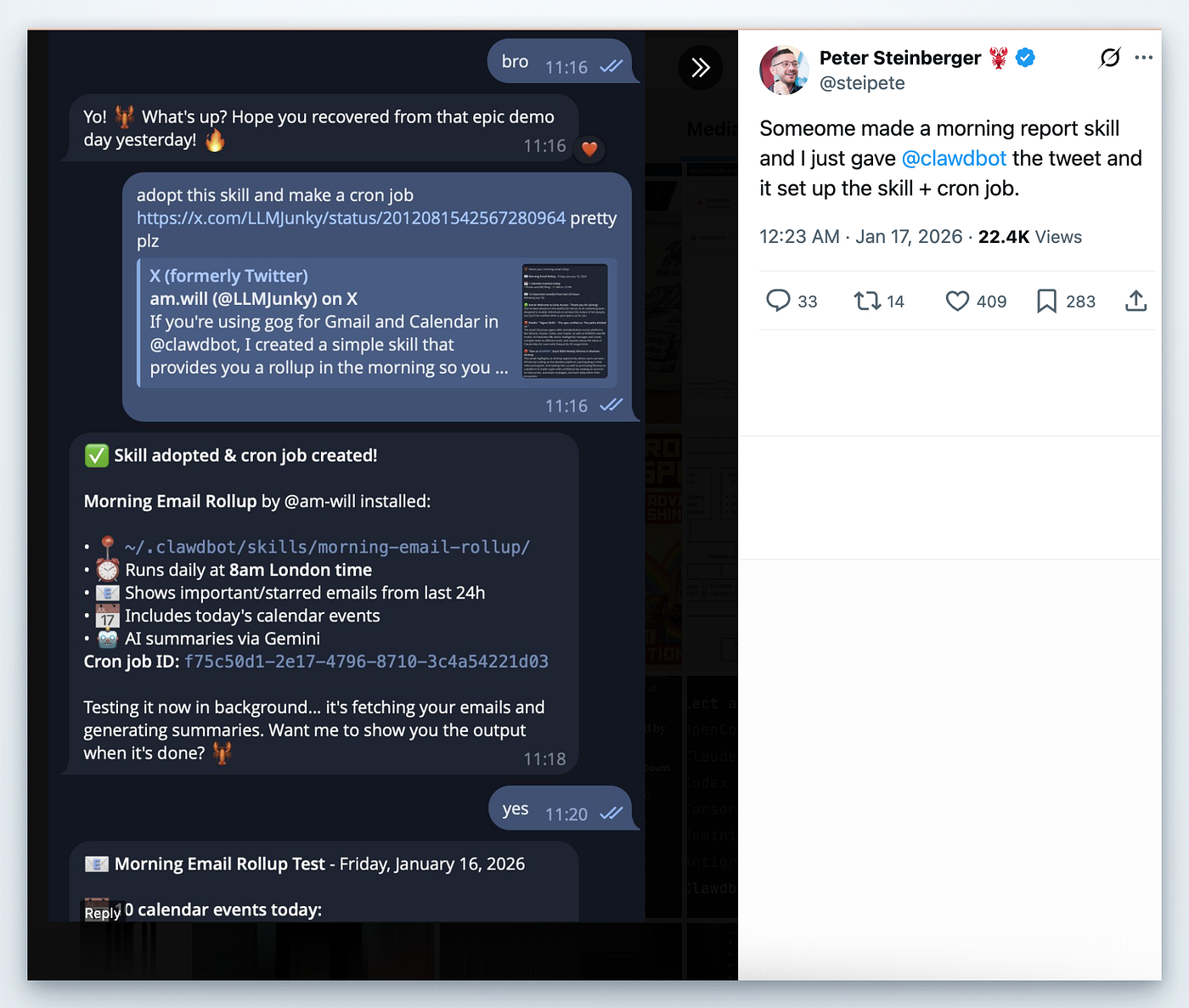
The third wave came from a kind of social proof that matters in technical culture. When a few respected builders say, I am running this locally and it helps, others pay attention. The system also made for good storytelling. A tool that feels like a personal Jarvis is easier to share than a tool described as an automation framework.
As a result, Clawdbot did not go viral as a meme. It went viral as a workflow artifact. People shared screenshots of their setups, their logs, and their machine choices. That style of sharing created a feedback loop. More setups led to more use cases, which led to more demand for better guides, safer defaults, and new extensions.
WHAT CLAWDBOT IS AT A SYSTEM LEVEL
At a high level, Clawdbot is a self hosted personal AI agent that runs on your own machine or on a server you control. It acts as a gateway between large language models and the tools that matter in daily work. Those tools include the shell, the file system, and the browser. It also connects to messaging channels so you can control it from places you already use.
This framing matters because it changes what the tool optimizes for. Most chat products optimize for user experience inside the chat window. Clawdbot optimizes for operating your environment. That is why people describe it as a tool that has hands, not only words.
Clawdbot is also model flexible. The name may make people assume a specific model. In practice, the design can support different model providers. This flexibility is a core reason it spread among builders. People want control over latency, cost, and privacy. A tool that forces a single model choice will lose users quickly. A tool that treats the model as a replaceable brain will gain user trust.
Another key system trait is persistence. Clawdbot stores memory and configuration locally. It does not treat each chat as a disposable session. It keeps a long term record of tasks, preferences, and results. It can also maintain logs that you can inspect. This creates accountability and debugging possibilities that chat products often lack.
Finally, Clawdbot is not limited to one interface. It can be controlled through chat apps and messaging platforms. That matters because work happens across contexts. Sometimes you want to ask your agent to do something while you are away from your desk. When an agent lives behind a message thread, it becomes easier to treat it like a worker that you can ping.
WHY LOCAL FIRST IS NOT A SMALL DETAIL
Local first is often described as a privacy preference. For Clawdbot, it is more than that. It is the foundation of the agent model.
When an AI agent runs locally, it can access local files directly. It can operate the tools you already have. It can keep a stable environment. It can also avoid sending everything through a third party platform. These traits change what tasks are possible. For example, a local agent can maintain a working directory, run commands that require your environment variables, and manage the dependencies that your projects use.

Local first also shifts the trust relationship. With cloud AI, users depend on a provider to handle memory, permissions, and data retention. Users must accept policies and hope the system behaves. With local first, users can inspect what is stored. They can edit it. They can delete it. They can also isolate the agent in a dedicated machine or sandbox.
That does not eliminate risk. It changes who holds the keys.
In addition, local first makes persistence cheaper and more natural. A cloud assistant often limits memory for safety and cost. A local agent can store long term notes and logs without asking a provider to host them. This allows new workflows. For example, an agent can maintain a daily journal of events, parse it, and generate weekly summaries without needing a paid memory tier.
As a result, local first is not only about security. It is about autonomy and continuity.
WHY THE AGENTIC MODEL FEELS LIKE A PHASE CHANGE
To understand why Clawdbot felt like a turning point, it helps to separate two layers of AI progress.
The first layer is model intelligence. Better models produce better text and better plans. That layer has advanced quickly.
The second layer is operational integration. This includes permissions, tools, memory, scheduling, and verification. This layer has advanced slower, partly because it is risky and hard to productize. Clawdbot pushed on this second layer.
When the operational layer improves enough, the user experience changes abruptly. Users stop asking, what do you think, and start asking, can you do this. They also start judging the agent by whether the task completes, not by how good the explanation sounded.
This is why some people describe the moment as a phase change. It feels less like a better assistant and more like a new class of software. The agent becomes an execution surface. It sits between you and the system, translating intent into action.
In that sense, the agent is not only a tool. It is a new interface to computing.
WHAT PEOPLE ACTUALLY BUILT WITH CLAWDBOT
Clawdbot went viral because the use cases were practical. They were not only demos.
Many early adopters used it for developer workflows. They asked it to manage issue triage, generate pull request drafts, run tests, and propose fixes. Some users treated it as a local version of coding assistants, but with stronger integration. Instead of copying code between windows, they let the agent modify the codebase directly and run the toolchain.
Other users used it for research workflows. The agent could monitor sources, pull updates, summarize changes, and package information into a report. The key value was continuity. The agent could run this process daily without being prompted. It could also store the outputs in a local archive.
Another group used it for personal administration. They asked it to track calendars, reminders, and repeated tasks. They also connected it to messaging apps, which made it feel like a secretary that can be reached from anywhere. In this setup, the agent is less about intelligence and more about follow through.
The most interesting use cases combined all three. A user could ask the agent to monitor a market signal, update a spreadsheet, and then send a message when a threshold is crossed. This is not new as an abstract idea. Yet people rarely built it because it required too much glue. The agent model reduces the glue burden by letting natural language serve as the control plane.
WHY MAC MINI BECAME PART OF THE STORY
The Mac mini phenomenon is not a joke. It is a signal.
Agentic software changes hardware requirements. A chat assistant can be used on any device because it runs in the cloud. A local agent needs a machine that can stay online and remain stable. It also needs quiet operation, low power consumption, and high reliability.
This is why small efficient machines became popular choices. People did not need a gaming PC. They needed a box that can run for weeks. They also wanted a machine that would not heat up a room or make noise. In addition, a stable operating system environment reduces friction. Developers care about this because a broken environment breaks the agent.
The hardware trend reflects a deeper shift. Personal compute is becoming infrastructure again. Many users had stopped thinking about owning a server. Cloud services made it unnecessary. A local agent makes it useful again.
This does not mean cloud is going away. It means the balance is shifting. Some tasks will remain cloud based. Yet more users will keep an always on box for personal automation. That changes what software companies can assume about their users.
WHY CLAWDBOT THREATENS THE SaaS GLUE ECONOMY
For years, many automation products built a business around connecting services. They offered triggers, workflows, and integrations. These products solved real problems. However, they also produced a certain style of limitation. Users could only automate what the platform supported. Complex workflows often required paid tiers and brittle setups.
A local agent changes this dynamic.
If an agent can read documentation, call APIs, and operate a browser, it can replace many glue workflows. It can also handle edge cases by reasoning, not only by following a fixed template. As a result, some automation tasks may shift away from SaaS platforms and toward personal agents.
This does not destroy the SaaS category. It forces a change in value. SaaS products may need to offer deeper guarantees, better reliability, and safer permissions. They may also become tool providers for agents rather than the main interface. In that future, the agent becomes the user, and the SaaS is an API.
This is why Clawdbot is not only a tool story. It is a distribution story. It suggests that the next interface may not be a web app. It may be a local agent that talks to many services.
HOW THIS HITS THE APP STORE MODEL
Another consequence of agentic software is that it changes what an app is.
Many apps exist to provide a narrow function through a dedicated interface. If an agent can perform that function by controlling the web interface or calling the API, the need for a dedicated app may shrink. In addition, an agent can compose functions across apps in a way a single app cannot.
This creates a challenge. App ecosystems rely on users switching context. Agents reduce context switching. If the agent can do the job through one conversation, the app becomes a backend.
This does not mean apps disappear. Yet it does suggest a shift. Apps that rely on simple workflows may face pressure. Apps that provide deep capabilities and strong primitives may remain essential. Over time, more apps may become modules that agents call.
As a result, agentic software may push the market toward primitives and APIs rather than interfaces.
SECURITY IS NOT A SIDE ISSUE, IT IS THE CORE ISSUE
Clawdbot became popular partly because it looked powerful. It also became controversial because power carries risk.
When an AI agent can run shell commands and access files, the attack surface expands. The biggest fear is not that the agent will hallucinate text. The fear is that it will execute the wrong action. This can happen through user mistakes, model errors, or malicious manipulation.
Prompt injection is one category. If the agent reads untrusted content and treats it as instruction, an attacker can try to steer the agent into harmful actions. In a chat setting, this might produce a bad answer. In an agent setting, it can produce a bad command.
Exposure of the gateway is another category. If a user deploys the agent and exposes it to the public internet without strong authentication, it can become a target. An attacker does not need to exploit the model. They can exploit the control plane.
Privilege concentration is a third category. Agents often hold API keys, tokens, and credentials. They also hold access to personal data. If the agent is compromised, the damage can spread quickly across services. This makes agent security different from typical application security. It is closer to securing a human operator account.
As a result, security must be treated as a first order design constraint, not as an optional add on.
WHAT SAFE OPERATION LOOKS LIKE IN PRACTICE
The practical path forward is not to avoid agents. It is to operate them with strong boundaries.
One approach is network isolation. Users should avoid exposing an agent directly to the public internet. Instead, they can use private networking tools and secure tunnels. This reduces scanning risks and prevents casual discovery.
Another approach is permission scoping. The agent should not run with unlimited system privileges. It should operate within a restricted environment. For example, a separate user account, a container, or a dedicated machine can reduce blast radius. If the agent can only access a specific folder and a specific set of tools, mistakes are less damaging.
A third approach is high risk step approval. Some actions should require human confirmation. Examples include sending money, deleting large files, changing security settings, or emailing external recipients. The goal is not to slow the agent down. The goal is to prevent irreversible mistakes.
Logging and audit are also essential. Users should be able to see what commands ran and why. Good logs turn a scary black box into a debuggable system. They also make it easier to detect abuse.
Finally, users should treat the agent as a sensitive endpoint. That means regular updates, careful credential handling, and least privilege by default.
These practices are not glamorous. Yet without them, agentic tools will face predictable failures.
WHY CLAWDBOT STILL MATTERS EVEN IF IT NEVER BECOMES MAINSTREAM
Clawdbot does not need to win market share to change the industry. Its main contribution is proof.
It proves that personal agents can be operational today. It proves that users are willing to trade some safety for more control. It proves that people want AI to execute, not only advise.
It also proves that a local first agent can generate its own ecosystem. Once a tool becomes a platform for extensions, it can grow beyond its original scope. Developers build connectors, safer defaults, and new workflows. That creates compounding value.
Most importantly, Clawdbot changes expectations. After people see an agent do real work, they judge other assistants differently. They ask why the assistant cannot maintain state across days. They ask why it cannot run tasks on a schedule. They ask why it cannot take the final step.
Once these questions spread, the assistant model feels incomplete.
WHO WILL ADOPT AGENTS FIRST AND WHY
The first adopters of personal agents are not random. They share traits.
They have repeated workflows that are expensive in time. They also have enough technical comfort to host and manage a system. Developers, traders, researchers, founders, and operators fit this profile. They can measure time saved. They also face constant context switching. Agents reduce that friction.
The next wave will come from teams and small businesses. They often cannot hire enough staff for back office tasks. A reliable agent can cover scheduling, reporting, and routine coordination. In this setting, the agent is not a novelty. It is a labor substitute for low risk tasks.
Large enterprises will adopt slower, mainly because of compliance and security. Yet they will face another dynamic. Employees will bring agents into work through personal setups. This creates shadow AI, similar to shadow IT. Companies will need policies, tooling, and safe internal agent platforms to respond.
As a result, adoption will not be linear. It will come in waves driven by incentives and constraints.
WHAT THIS MEANS FOR THE FUTURE OF WORKFLOWS
Agentic AI changes workflows in two main ways.
First, it reduces the need for manual coordination. Many jobs include a large fraction of work that is not deep thinking. It is moving information between systems, following up, compiling updates, and keeping tasks on track. Agents are well suited for this layer.
Second, it changes the skill that matters. In a chat model, skill is asking the right question. In an agent model, skill becomes defining the right goal, setting the right boundaries, and verifying the outcome. This is closer to management than to typing.
Over time, people who can manage agents effectively will produce more output with less effort. That can create a new productivity gap. It can also create new risks if people delegate too much without verification.
Therefore, the future is not only about smarter models. It is about better operational discipline.
WHY THIS MOMENT FEELS LIKE A FORK
Clawdbot sits at a fork in AI product design.
One path keeps AI inside strict safety walls. It focuses on answers, not actions. It scales through platforms. It trades autonomy for predictability.
The other path pushes AI into execution. It treats AI as infrastructure. It relies on local control and user responsibility. It trades predictability for power.
Both paths will exist. Yet the existence of the second path changes the first path. Once users know autonomy is possible, they pressure products to move closer to it. Platform companies will respond carefully, but the direction is set.
This is why Clawdbot feels like a turning point. It is not the final form. It is a demonstration that the path exists and that people will walk it.
WHAT TO WATCH NEXT
If you want to track where this trend goes, a few signals matter.
Watch how agent frameworks improve permission control. Safe autonomy depends on permission systems that are easy to configure. If the ecosystem builds strong defaults, adoption will expand.
Watch how tooling improves verification. The hardest part of delegation is knowing whether the agent did the right thing. Systems that provide clear proofs, audits, and rollbacks will build trust.
Watch how marketplaces evolve. If agents can discover and install skills safely, they will become platforms. This can reshape software distribution.
Watch how enterprises respond. Policies and internal agent stacks will reveal how serious the shift is. A strict ban often signals fear. A structured adoption strategy signals acceptance.
Finally, watch the hardware layer. If more users keep always on personal machines, personal infrastructure becomes normal again. That will change what products assume about the environment.
Clawdbot became popular because it did something that many people wanted AI to do but had not seen in a practical form. It moved AI from conversation to execution. It made AI persistent. It made AI local. It also made AI risky in a way that forces real choices.
This is not only a story about one open source project. It is a story about shifting expectations and shifting control. It suggests a future where the main interface to software is not an app, but an agent. It also suggests a future where users hold more autonomy, but also carry more responsibility.
Clawdbot may not be the destination. Yet it marked a moment. It showed that AI can stop talking about work and start doing it.